

Oversee · During construction
Built as it was designed.
Much of a solar plant is buried within weeks of being laid: piles, earthing, cable joints and trenches. The EPC contractor checks its own work. As your Owner's Engineer, Renevik checks it for you at every stage, before it is covered, energised or paid for.
Renevik provides Owner's Engineer services for solar plants under construction in India. We review the design, inspect modules at the factory, check the work on site at agreed hold points, witness the commissioning tests and sign off the handover, so the owner approves each stage from a checked record.
Why it matters
A fault buried is paid for every month.
A finding after commissioning is a dispute. A finding at a hold point is a correction.
We agree the hold points with you and the EPC contractor before work starts. Work moves on only when its check has passed, and every finding carries a marked photograph and a location tag.
Five stages
Five stages, five checks.
Design review.
Drawings, studies and the bill of materials checked against the standards and the site data, before procurement. How we check a design.
Factory.
Modules inspected at production and before dispatch, with third-party inspection.
Site.
Piles, structure, earthing and cabling checked at hold points, before they are covered.
Commissioning.
Every string tested against the voltage expected at its measured cell temperature, IV curves on chosen strings, and every relay setting witnessed.
Handover.
As-built drawings, test records and the plant's P90 expected yield, signed and filed, so its first month is read on the same basis as its twenty-fifth.
The owner's view of the build
Seen stage by stage, not at month-end.
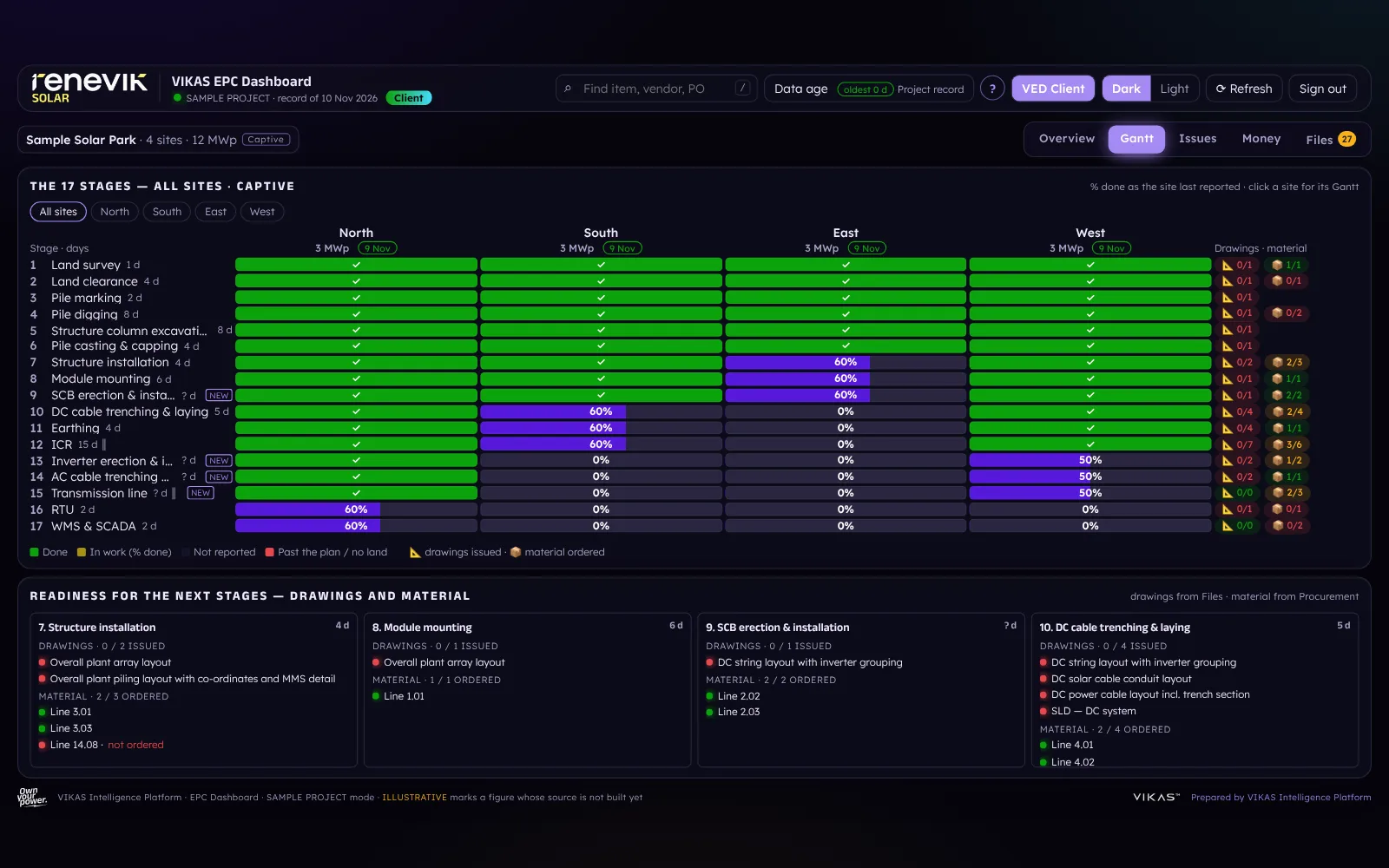
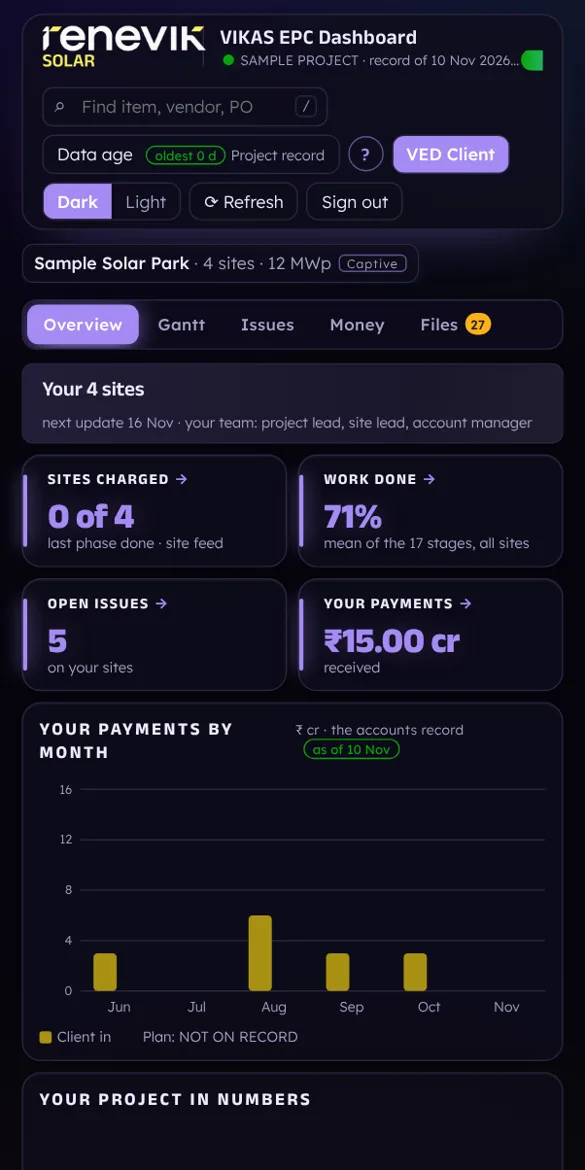
Every plant we oversee while it is built gets its own page in VIKAS EPC Dashboard (VED): the five stages, broken into 17 site steps, what is blocked and by whom, the drawings issued and the material ordered.
You see what we see. A slipped stage shows the week it slips, not in next month's report.
What we check on site
Ticked Pass, Fail or N/A, line by line.
From our inspection checklist, built on the IEC 62446-1 model inspection report. Every fail is written with its location tag and closed on the punch list.
- String voltage at the coldest cell inside every rating
- String fuses rated and fitted in both poles
- Connectors of one make and type, never cross-mated
- Frames, structures and inverters bonded to the earth grid
- Surge devices rated for the system
- Module clamps torqued to the maker's value
- Cable trenches backfilled, route markers set
- Danger boards and the as-built SLD in the control room
Our own builds
34.6 MW built by our own EPC team.
Seven plants in Gujarat and Maharashtra, among them our co-owned RadhaLaxmi sites (see Own). We oversee a build the way we run our own, and we read each plant we built against its P90 expected yield every month.
Regency Ispat's 4.5 MWp plant in Solapur: seven of eight months in 2026 at or above P90 once grid orders and the weather are counted.
How we work
Four principles behind every check.
For the owner
We report to you, not to the contractor. You approve every stage.
Evidence
Every finding comes with a marked photograph and a location tag.
Daily
The site record is read every day by VIKAS Intelligence Platform.
Proved
A stage closes only on a passed check or test.
Questions about construction oversight
Before the first pile.
What does an Owner's Engineer do during construction?
An Owner's Engineer checks the EPC contractor's work on the owner's behalf: the design before procurement, the modules at the factory, the work on site at agreed hold points, the commissioning tests and the handover documents. The contractor carries out the work; the owner approves each stage.
What is a hold point?
A hold point is a stage that the work cannot pass until its check has been done and passed, for example earthing before backfill, or string tests before the plant is energised. We agree the hold points with you and the contractor before work starts.
Can Renevik oversee a plant built by another EPC contractor?
Yes. That is the service: an independent check of another contractor's work. Renevik's own EPC record is the experience behind it.
What happens after commissioning?
The plant's P90 expected yield is fixed at handover from its as-built design. The plant can then move into our Owner's Engineer service for operating plants, read every day in VIKAS Generation Dashboard (VGD).
A plant being built
Start before the first pile.
Share the drawings and the construction schedule. We agree the hold points with you and the contractor, then start on day one on site.