

Engineer · Renevik Engineering
Your full drawing set in 5 working days.
An EPC loses weeks waiting for drawings: chasing a consultant, sending the same inputs twice, waiting for each revision. Every week a set waits is a week the build cannot start. Renevik Engineering draws the full set in 5 working days, with one brief and one contact, and checks every sheet before it reaches you.
Renevik Engineering draws full solar plant drawing sets for EPC companies and developers in India: plant and site layouts, DC and AC single line diagrams, cable, earthing and structure drawings, the electrical studies and the handover pack. Every sheet names its standard and stays for review until a licensed engineer stamps it.

Fast, and easy to work with
Days, not weeks.
One brief
We list every input we need once, up front. You never send the same paper twice.
One contact
One person answers for your set from the brief to the last revision.
Every change on the sheet
Each revision goes into the sheet's revision table with its reason, so nobody asks what changed.
Rs 50,000 per MW
More than a typical consultant and half the top fee on our record. The first design check is free.
How we compare
A typical engineer, a good one, and us.
What we found when we reviewed real plant designs, beside how Renevik Engineering draws a set.
| What we compare | Typical engineerthe weaker sets we have read | Good engineera top designer | Renevik Engineeringevery set we draw |
|---|---|---|---|
| Turnarounda full drawing set | 2–6 weeks | 2–6 weeks | 5 working days from complete inputs |
| Working with themfrom brief to last revision | Many follow-ups for each input and each revision | Good work, slow to revise | One brief, one contact; every change logged on the sheet with its reason |
| The setwhat the owner gets | Layouts and the single line diagram; switchyard, structure or studies often missing | A full drawing set | Up to 45 sheets, studies and handover pack included |
| Site testssoil, earth resistivity, pile load | No test reports with the set | Soil and resistivity read; no pile load test | Asked first; each sheet says NOT MEASURED until its test arrives |
| Strings and inverterdo they match? | String voltage falls below the inverter’s working range: power lost every day | Matched, but string fuses left off | Every string checked against the inverter and every rating; a missing maker value is flagged, not guessed |
| Lossesshade and cables | Cable losses over 2% on some runs | Rows shade each other on winter afternoons | Winter shade and every cable run’s loss shown on the sheet |
| Studiesearthing, lightning, short circuit, relays, structure | Layouts only, no studies; no structure calculation for the mounts | Done, but the earth strip is marginal and the structure check unsigned | All five drawn in the set; each names the site input it still waits for |
| Papers agreefrom one sheet to the next | They do not: a different weather site, transformer size or string count from paper to paper | Mostly; the module count differs between papers | One source: every sheet reads from the same calculation, checked by code |
| Who checks itbefore it is issued | The person who drew it | The structure check left unfactored and unsigned | Code, then our engineers; nothing is issued for construction until a licensed engineer stamps it |
| Energy lostto the design, every year | 1.7–2.9% of the plant’s energy | About 0.3%, estimated | Each loss found and priced on paper, before the build |
| Over 25 yearsper MW, at Rs 3 a unit | Rs 0.20–0.35 crore of power lost | About Rs 0.04 crore, estimated | Our extra Rs 20,000 over a typical fee is back within 3 months, from the mismatch alone |
| Design feeRs per MW | About Rs 30,000 | Up to Rs 1,00,000 | Rs 50,000: half the top fee on our record |
Based on solar plant designs we have reviewed. Worked for 1 MW of panels making 1,600 units per kW a year, at Rs 3 a unit. The 1.7–2.9% is what the designers' own energy models lose to the voltage mismatch; the 0.3% is our check's estimate of a top designer's shade and cable choices. No degradation or discounting applied. Market fees are figures on our record, not quotes.
What one set holds
A full set, not a part set.
The full set for a 3.6 MW AC ground-mounted plant runs to 45 sheets, each in two editions: print (A3, white) and screen (dark).
Base design.
Drawing list, strings and inverters, plant and site layout, DC and AC single line diagrams, cable schedule, earthing and lightning, structure and piles, bill of materials, protection and CEIG checklist, cost review.
Electrical.
DC string and cable routing, AC routing, inverter and transformer yard, switchyard and HT panel, HT/LT schematic with relays and metering, auxiliary power, SCADA, CCTV and weather station.
Civil and structure.
Grading and drainage, roads and fence, cable trenches, foundations, control room, mounting structure GA and fabrication, structure loads.
Studies.
Earthing study, lightning risk, short circuit, relay coordination, lighting and fire layout.
Handover.
Safety labels, documentation index, commissioning tests, inspection checklist, as-built list and the O&M handover.
Real sheets
From a set we drew.
Two sheets from our set for a 3.6 MW AC ground-mounted plant, as drawn: the plant layout on its traced boundary and the AC single line diagram. The client, the site and the plant ID are hidden.
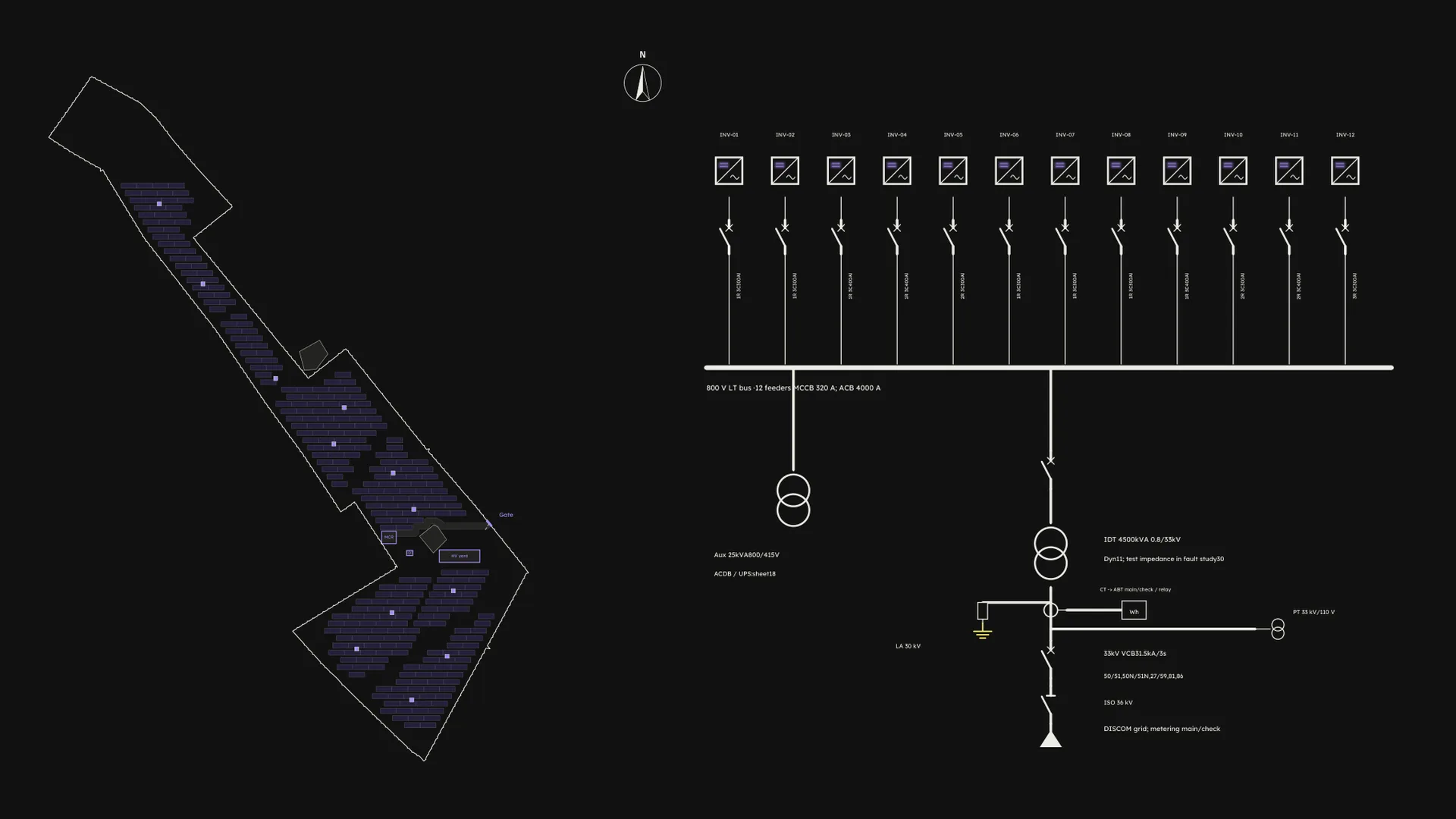
string length sized from the module data sheet.
string voltage at the coldest cell, inside the 1,500 V rating.
each on a 320 A breaker, with a 4,000 A incomer on the LT bus.
transformer to 33 kV, its impedance carried into the fault study.
How a set is made
Calculated, drawn, checked, then stamped.
VIKAS Intelligence Platform calculates and draws every sheet from your site data. Our engineers check it, and a licensed engineer stamps it before construction.
One brief.
The boundary and contour survey, soil and earth resistivity, equipment data sheets and the grid fault level, asked once.
Calculate.
Strings, cable sizes and voltage drop, fault levels, earthing and structure loads, each kept with the set.
Draw.
Every sheet, in print and screen editions, with the standard behind it printed on the sheet.
Check by code.
Each number re-checked across the whole set.
Review.
Our engineers read every sheet against its standard.
Stamp.
Every sheet reads FOR REVIEW · NOT FOR CONSTRUCTION until a licensed engineer stamps it.
Why it gets better every week
It learns faster than any one engineer.
An engineer learns from the plants they work on, a few a year, and the lessons stay in one head. VIKAS learns from every plant it reads, every paper and every correction, and turns each lesson into a check it runs on every set.
One engineer
- Plant 1
- a year later, plant 2
- a year later, plant 3
A lesson learnt on one plant may not reach the next drawing, or the next engineer.
VIKAS
- Every plant, read every day
- Every paper, read and noted
- Every correction, made a check
A correction made today is checked on every sheet of every set tomorrow.
engineering sources catalogued in two days, 62 of them read in full: standards, textbooks and field studies.
design rules, each tied to its source; the checks built from them run by code on every set.
of solar assets read by VIKAS, so the rules meet real plants.
The standards we draw to
Each sheet names its standard.
A sheet says "compliant" only after the clause has been read. An edition not yet read is marked on the sheet, not hidden.
- CEA Safety Regulations 2023
- IEC 62548-1
- IEC 62446-1
- IEC 60364-7-712
- IEC 60364-5-52
- IS 3043
- IEC 62305-2
- IEC 60909
- IEC 61082-1
- IEC 60617
- ISO 5457
- ISO 7200
Until a site input arrives, the sheet that needs it says so and prints the value as assumed. Nothing is filled in by guesswork.
What we offer
For EPC companies and developers.
Full plant set
Up to 45 sheets for a ground-mounted or rooftop plant in 5 working days, in print and screen editions. Rs 50,000 per MW.
Design check
Your existing design read against its standards in 5 working days, with what we would change and why. The first one is free.
Single studies
Earthing, lightning risk, short circuit or relay coordination, on their own.
Cost review
Savings looked for at design stage, each one shown with its calculation.
As-built and handover
As-built drawings, the inspection checklist and the O&M handover pack.
Owner's Engineer
Renevik checks the plant for its owner, during construction and in operation.
Questions about engineering
Before you send a design.
What does a free design check give me?
Send one existing design: the single line diagram, the layout and the PVsyst report. Within 5 working days of a complete design we return two pages: what we would change, why, and the standard behind each point. It is a review opinion, not a stamped design, and your engineer stays engineer of record.
Are the drawings stamped?
Every sheet reads FOR REVIEW · NOT FOR CONSTRUCTION until a licensed engineer stamps it. We say so on the sheet rather than print a stamp that is not there.
What do you need from us to draw a full set?
The site boundary and contour survey, soil investigation and earth resistivity, the module, inverter and transformer data sheets, the grid fault level at the connection point, and the load and connection route. A pile load test is needed before piles are approved.
Is our design kept confidential?
Yes. The files you send are used only for your check or your set, kept confidential and deleted on request.
Can Renevik also check the plant while it is built?
Yes. Renevik's Owner's Engineer service during construction checks a plant at every stage, from design review to handover, on the owner's behalf.
A free design check
Send us one design.
Send the single line diagram, the layout and the PVsyst report. We read it in 5 working days and send two pages back: what we would change, why, and the standard behind each point.